AI Training in the United Kingdom (UK)

AI Training in the United Kingdom (UK): Enterprise Generative AI Training for 2026
Corporate Training in ChatGPT, Claude AI, Gemini, Microsoft Copilot 365, Agentic AI, Prompt Engineering and AI Automation

Artificial intelligence training in the United Kingdom is entering a very different phase in 2026.
British organisations are moving beyond asking employees to "try ChatGPT" and towards a much more important challenge:
How do we turn AI into a secure, repeatable and measurable business capability?
The UK government has expanded its AI Skills Boost initiative with an ambition to help upskill 10 million workers by 2030. Skills England is simultaneously encouraging organisations to make AI learning practical, role-specific and integrated into real work.
For companies searching for AI Training in United Kingdom, this means a modern programme should cover much more than AI theory.
Employees increasingly need to understand how to:
use ChatGPT, Claude, Gemini and Microsoft Copilot effectively;
select the right AI model for different jobs;
build reliable prompts and reusable workflows;
work with documents, spreadsheets, presentations and research;
automate repetitive processes;
understand Agentic AI;
protect confidential information;
review AI output before business use;
comply with organisational AI policies;
and translate AI experimentation into measurable productivity.
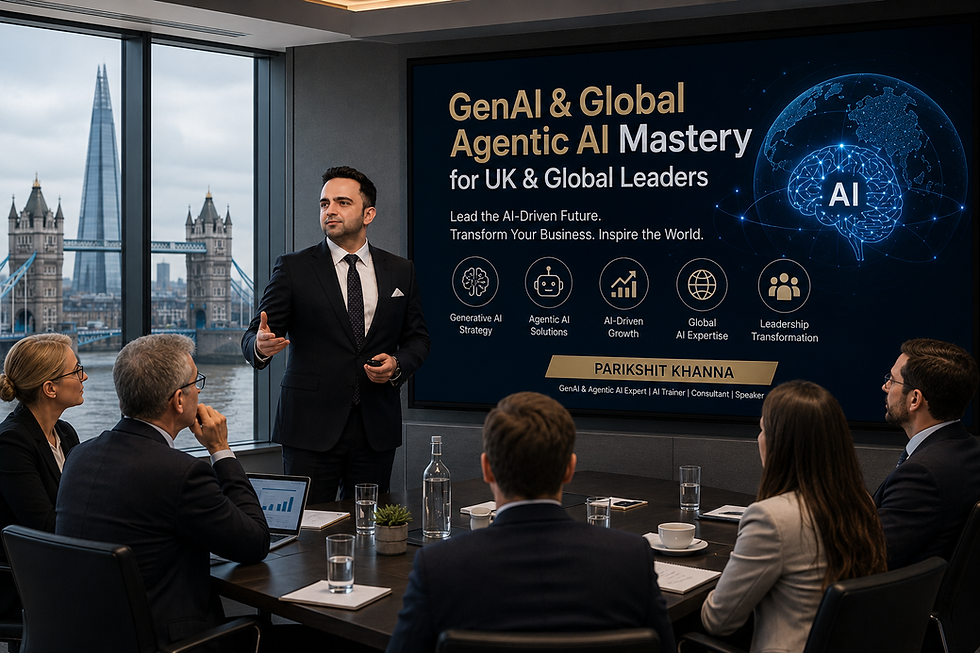
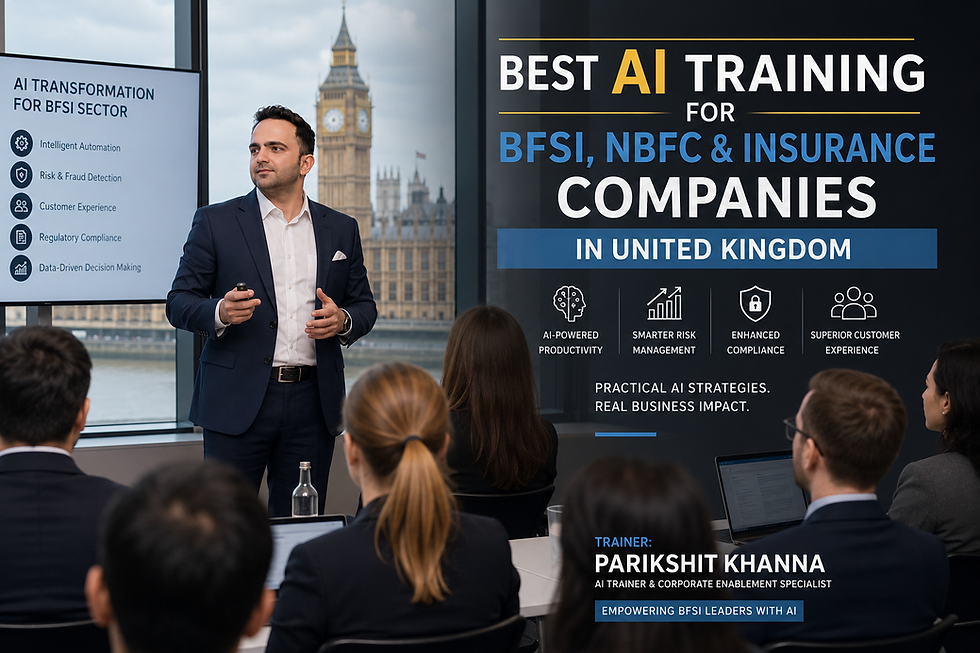
That is the approach behind corporate AI programmes delivered by Parikshit Khanna and Digital Training Jet.
Meet Parikshit Khanna: TEDx Speaker & Enterprise AI Trainer

Parikshit Khanna is a TEDx Speaker, Corporate AI & Generative AI Trainer, Prompt Engineering specialist, Founder of Digital Training Jet, and Visiting Faculty at GL Bajaj Institute of Management and Research.
His professional journey includes AI training and enablement connected with leading corporations and institutions such as Tata Group, LG Electronics, VISA, Siemens, IIT Delhi, IIT Roorkee and IIM Bangalore, with recognition extending to Times Square, New York.

His expertise covers Claude AI, ChatGPT, Gemini, Microsoft Copilot 365, Prompt Engineering, Agentic AI, AI Automation, n8n, Custom AI workflows, executive AI adoption, and AI applications for Finance, HR, Sales, Marketing, Manufacturing, Healthcare and Operations.
Global Recognition
TEDx Speaker | Times Square, New York | Corporate & Executive AI Trainer | Founder, Digital Training Jet
The official TED platform lists Parikshit Khanna as a speaker at TEDxEicher School Faridabad Youth, where his profile identifies him as an AI and digital marketing trainer and entrepreneur.

Why AI Training Matters for UK Businesses in 2026

AI adoption is increasingly becoming a workforce issue rather than simply an IT issue.
UK government research published in 2026 projects that roles involving core AI activities could eventually account for approximately 3.9 million workers by 2035, while millions more are expected to work in occupations where AI becomes adjacent to their existing responsibilities.
The implication for business leaders is significant.
Companies will not necessarily need every employee to become an AI engineer.
They will need employees who understand how to work intelligently with AI.
A finance manager may need AI for management reporting.
A salesperson may need it for account research and follow-up.
An HR professional may use it for competency mapping and learning programmes.
A marketing professional may need it for research, campaign planning and content workflows.
An operations manager may use it for SOPs, process analysis and documentation.
An executive may need AI for research, scenario analysis and decision support.
This is why corporate AI training needs to be connected directly to work.
What Can Be Covered in Parikshit Khanna's UK AI Training Programme?

1. Generative AI Foundations for Business
Participants understand what modern generative AI can and cannot do.
Topics can include:
Large Language Models, multimodal AI, hallucinations, model limitations, context windows, verification, AI reasoning, responsible use and choosing appropriate tools.
The purpose is not to turn business professionals into data scientists.
It is to make them informed AI users.
2. Advanced Prompt Engineering
Poor instructions create poor AI output.
Participants learn how to structure prompts using:
Role + Objective + Context + Constraints + Examples + Output Format + Verification
Employees can then convert successful prompts into reusable organisational templates.
Instead of repeatedly asking AI to "write a report", teams learn how to define the audience, purpose, source information, assumptions, structure and quality criteria.
3. ChatGPT Training for UK Corporate Teams
ChatGPT can be applied across:
research;
brainstorming;
report drafting;
document analysis;
email communication;
customer research;
management summaries;
meeting preparation;
data interpretation;
presentations;
strategy development;
and workflow design.
The emphasis should remain on professional quality and verification, not simply generating more content.
4. Claude AI Training
Claude can be incorporated into programmes involving:
long-document analysis;
research;
professional writing;
policy comparison;
structured information extraction;
project-based workflows;
reusable AI instructions;
document creation;
analytical work;
and complex knowledge-worker tasks.
Claude training can also introduce organisations to more advanced workflow concepts as their AI maturity grows.
5. Google Gemini Training
Gemini adds another important component to a multi-model enterprise AI strategy.
Sessions can explore:
multimodal prompting;
research;
document assistance;
visual understanding;
Google Workspace-oriented workflows;
ideation;
analysis;
and content development.
The objective should not be deciding that one model is universally "best".
Employees should understand which model is more appropriate for a specific task.
6. Microsoft Copilot 365 Training
For organisations already working inside the Microsoft ecosystem, Copilot training can have immediate relevance.
Training can include practical use of Copilot with:
Microsoft Word
Drafting, summarisation, rewriting, document comparison and structured business documentation.
Microsoft Excel
Data exploration, formula assistance, trend interpretation and management commentary.
Microsoft PowerPoint
Building presentation structures, executive summaries and slide narratives.
Microsoft Outlook
Email summaries, professional responses, action extraction and communication support.
Microsoft Teams
Meeting summarisation, action items, conversation analysis and preparation.
The goal is not simply acquiring Copilot licences.
It is achieving Copilot adoption.
7. Agentic AI Training
The enterprise AI conversation is moving beyond individual prompts.
Agentic AI introduces systems capable of completing multi-step processes involving instructions, tools, information and actions.
Participants can learn:
what an AI agent is;
when agents are appropriate;
how agents differ from chatbots;
workflow decomposition;
tool connections;
human approval checkpoints;
AI agent risks;
governance;
and enterprise use cases.
The ICO has highlighted that organisations integrating Agentic AI remain responsible for data-protection compliance and must consider issues including system access, purpose, automated decision-making and governance controls.
8. n8n and AI Automation
Prompting creates an answer.
Automation creates a repeatable process.
An advanced corporate AI programme can therefore introduce platforms such as n8n for workflows involving:
lead information → AI analysis → CRM update → follow-up → notification → reporting
Other examples include:
customer enquiry routing;
research monitoring;
document processing;
content workflows;
internal reporting;
lead qualification;
meeting follow-ups;
and recurring operational processes.
Human approval can remain part of the workflow wherever necessary.
9. Responsible AI and UK GDPR Awareness
For UK businesses, AI productivity cannot be separated from information governance.
The Information Commissioner's Office provides specific guidance about applying UK GDPR principles to AI and offers tools designed to help organisations identify data-protection risks associated with AI systems.
Employees should therefore understand the difference between:
Public information
Internal information
Confidential business information
Personally identifiable information
Sensitive or regulated information
Training can demonstrate when information should not be pasted into public AI systems and why company-approved environments, permissions and policies matter.
Responsible AI training can also cover:
hallucination management;
fact verification;
source validation;
human review;
bias awareness;
data minimisation;
access controls;
approval workflows;
AI-generated content review;
and accountability.
AI Training for CEOs, CXOs and Senior Leadership

Leadership training should be significantly different from general employee training.
Executives need to understand:
where AI creates genuine competitive advantage;
which processes should be automated;
where human judgement must remain;
AI investment priorities;
organisational governance;
workforce impact;
data exposure;
change management;
vendor evaluation;
and ROI.
An executive programme can therefore focus on moving leadership from:
AI Awareness → AI Prioritisation → AI Pilots → Governance → Enterprise Adoption → ROI
AI Training for Finance and FP&A Teams
Relevant workflows can include:
management reporting;
variance commentary;
financial research;
scenario-development support;
presentation preparation;
policy summarisation;
management communication;
data interpretation;
and recurring reporting workflows.
Financial outputs should always retain appropriate professional review.
AI Training for HR and Learning Teams
Possible activities include:
job-description development;
competency frameworks;
training-needs analysis;
learning design;
policy drafting;
employee communication;
interview preparation;
survey analysis;
and knowledge-management workflows.
AI Training for Sales and CRM Teams
AI can support:
account research;
lead qualification;
meeting preparation;
customer-persona development;
proposal drafting;
follow-up communication;
CRM note summarisation;
objection handling;
and sales enablement.
AI does not replace the relationship.
It can help the salesperson arrive better prepared.
AI Training for Marketing Teams
Marketing programmes can cover:
customer research;
competitor analysis;
content planning;
SEO research;
campaign briefs;
copy variations;
social-media repurposing;
creative ideation;
analytics narratives;
presentation creation;
and marketing automation.
AI Training for Manufacturing and Operations
Manufacturing teams can explore AI for:
SOP development;
maintenance documentation;
shift handovers;
supplier communication;
process mapping;
root-cause brainstorming;
technical knowledge retrieval;
quality documentation;
training material;
and operational research.
AI Training for Healthcare and Pharmaceutical Teams
Healthcare and pharmaceutical organisations require particularly careful use of AI.
Relevant training can include human-reviewed workflows for:
research summarisation;
training material;
professional communication;
documentation;
market research;
internal knowledge;
operational processes;
and structured information extraction.
Privacy, accuracy and expert review should remain central.
AI Training for Professional Services
London and the wider UK have major legal, accounting, consulting, financial and professional-services ecosystems.
AI training for these organisations can focus on:
client research;
document review;
meeting synthesis;
executive briefs;
proposal development;
knowledge management;
report preparation;
and professional communication.
Practical AI Training Instead of Another Generic AI Presentation
A major weakness of traditional AI training is that employees watch demonstrations but return to work without knowing what to do next.
A stronger programme should use participants' actual job categories.
For example:
A salesperson practises customer research.
A finance professional creates management commentary.
An HR professional builds a competency framework.
A manager creates an executive briefing.
A marketing professional turns research into a campaign brief.
An operations employee improves an SOP.
The employee therefore leaves with a workflow, not merely a list of tools.
The PRIMES Approach to Effective AI Upskilling
Skills England's 2026 research identified six principles for effective AI training through the PRIMES framework.
AI learning should be:
PracticalConnected with real tasks and decisions.
ReachableAccessible to employees across different skill levels and formats.
IntegratedConnected to work, organisational systems, standards and governance.
ModularSuitable for different roles and starting points.
ExpandableCapable of scaling from individuals to departments and organisations.
SustainableContinuously updated as AI technology changes.
This approach strongly supports role-based enterprise training rather than one generic AI lecture for every employee.
AI Training Delivery Across the United Kingdom
Corporate AI programmes can be designed for onsite, virtual or hybrid delivery, subject to scheduling and commercial arrangements.
Programmes can support organisations and distributed teams operating across:
London, Manchester, Birmingham, Leeds, Liverpool, Bristol, Edinburgh, Glasgow, Cambridge, Oxford, Reading, Sheffield, Nottingham, Newcastle, Leicester, Coventry, Southampton, Cardiff and Belfast.
Possible formats include:
Executive AI Briefing
90 minutes to 3 hours
One-Day Generative AI Workshop
Hands-on productivity and prompting
Two-Day Corporate AI Programme
Multi-tool and role-based workflows
Three-Day AI Productivity and Automation Programme
Generative AI + Copilot + workflows
Five-Day Enterprise AI Bootcamp
Departmental adoption, governance and automation
Seven-Day Advanced AI Programme
Generative AI + Agentic AI + automation + implementation roadmap
Custom programmes can also be created for annual Learning & Development initiatives.
What Should Participants Be Able to Do After AI Training?
A well-designed AI training programme should enable employees to:
choose the appropriate AI tool for a task;
write structured prompts;
review AI-generated information;
identify hallucinations and weak outputs;
work productively with documents and business information;
use ChatGPT, Claude, Gemini or Copilot appropriately;
create reusable prompt libraries;
identify automation opportunities;
protect confidential information;
understand when human review is required;
and create practical AI use cases for their department.
Training success should ultimately be measured through behaviour and business outcomes, not attendance certificates alone.
Why Choose Parikshit Khanna for AI Training in the United Kingdom?

UK organisations have many choices for AI learning, including universities, vendor academies, large training organisations, consultants and independent trainers.
Parikshit Khanna's distinctive positioning is suitable for organisations looking for multi-tool, business-oriented enterprise AI training.
Multi-Tool Training
ChatGPT + Claude + Gemini + Microsoft Copilot 365 rather than dependence on a single platform.
Business-First Training
Real reports, research, documents, meetings, presentations, spreadsheets and workflows rather than abstract demonstrations.
Executive and Employee Training
Programmes can be adapted for CXOs as well as departmental teams.
Beyond Prompt Engineering
Training can progress into AI workflows, Agentic AI and n8n automation.
Governance-Aware
Responsible AI, verification, data protection and human review can be incorporated into the curriculum.
Sector-Specific
Activities can be redesigned around Finance, HR, Sales, Marketing, Healthcare, Manufacturing and Operations.
Frequently Asked Questions About AI Training in the United Kingdom
Who is this AI training suitable for?
CEOs, CXOs, managers, department heads, finance professionals, HR teams, marketers, sales professionals, operations teams, healthcare professionals, manufacturing employees and other business knowledge workers.
Can Parikshit Khanna conduct onsite AI training in the UK?
Onsite corporate programmes can be discussed subject to scheduling, travel, cohort requirements and commercial agreement. Virtual and hybrid formats can also be arranged.
Which AI tools can be included?
Programmes can cover ChatGPT, Claude AI, Google Gemini, Microsoft Copilot 365, Prompt Engineering, Agentic AI, Custom AI workflows and n8n automation.
Is coding required?
No. Corporate productivity programmes can be designed for non-technical employees.
Advanced automation material can be adapted for technical or mixed-skill groups.
Can the programme be customised?
Yes.
A strong corporate programme should begin by understanding job roles, existing AI tools, company policies, workflows and the outcomes leadership wants to achieve.
Can you deliver only Microsoft Copilot training?
Yes.
Dedicated Microsoft Copilot 365 programmes can be created around Word, Excel, PowerPoint, Outlook and Teams.
Can you deliver only Claude AI training?
Yes.
Claude-specific corporate workshops can focus on professional research, writing, documents, Projects, analysis and reusable workflows.
Can Agentic AI be included?
Yes.
Advanced programmes can introduce AI agents, workflow orchestration, approval checkpoints and Agentic AI governance.
Does the programme include responsible AI?
Responsible AI can be embedded throughout the programme, including privacy awareness, verification, confidential information, AI limitations, human review and governance.
How should companies measure AI-training ROI?
Useful measures include:
time saved;
reduction in repetitive work;
quality improvement;
employee adoption;
approved AI use cases;
reduction in rework;
workflow automation;
employee confidence;
and compliance with organisational AI standards.
Book Corporate AI Training in the United Kingdom
AI training should no longer be treated as a motivational technology session.
It should help employees change how work gets done.
For organisations that want to move from casual AI experimentation to practical, governed and measurable enterprise adoption, Parikshit Khanna and Digital Training Jet can develop customised programmes around your workforce, approved technology environment, target workflows and business priorities.
Parikshit KhannaTEDx SpeakerCorporate AI & Generative AI TrainerPrompt Engineering & Agentic AI TrainerFounder, Digital Training Jet
Phone / WhatsApp: +91 99972 13177 | +91 80762 50669
Website: ParikshitKhanna.com | DigitalTrainingJet.com

Comments